“The Orders Look Correct… So Why Don’t the Settlement Amounts Match?”
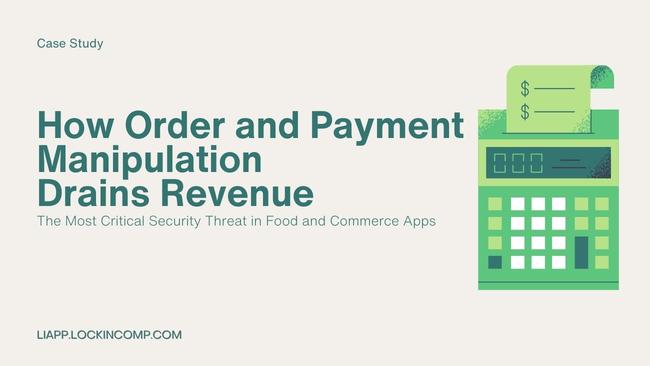
The Most Devastating Security Incident: Order and Payment Amount Manipulation
One day, the settlement team at a franchise headquarters received an unusual report.
-
Order volumes matched expectations, but revenue was lower than expected
-
Discrepancies repeatedly occurred at specific locations
-
All payment gateway (PG) transactions appeared to be successfully approved
At first, it looked like a simple accounting error.
However, the same issue continued to appear day after day.
The real problem was not the server.
It was the app that created the orders.
Why Is Order and Payment Manipulation the #1 Threat?
In food and beverage applications, orders and payments are money.
Any compromise in this area creates immediate consequences.
Direct Financial Loss
-
Reduced order amounts
-
Manipulated quantities and options
-
Distorted fees and commissions
Settlement Errors Leading to Franchise Disputes
-
“The headquarters system is incorrect.”
-
“We received the order exactly as submitted.”
Escalation into Legal and Trust Issues
-
Loss of franchisee confidence
-
Customer complaints
-
Liability concerns for the platform operator
This is why order and payment manipulation remains one of the most critical security threats.
A Real-World Case: Small Orders, Massive Losses
A food delivery and membership platform discovered a suspicious pattern.
-
Daily losses appeared insignificant
-
Individual transactions involved only small amounts
-
The activity repeatedly originated from specific accounts and devices
For weeks, the anomalies went unnoticed.
After a month, however, cumulative losses had reached tens of millions of won.
The attackers deliberately kept their activity below the radar.
How the Attack Worked
The attack was much simpler than many people imagine.
Traffic Hooking
Attackers intercepted network requests generated by the app.
Analysis of Encrypted Request Structures
The communication flow was analyzed to understand how order information was transmitted.
Manipulation of Order API Parameters
Attackers modified:
-
Order amounts
-
Quantities
-
Option pricing
-
Fee values
Normal Payment Processing
The payment itself was approved successfully.
Server logs showed:
“Normal.”
Payment gateway results showed:
“Approved.”
The server simply processed the manipulated values as legitimate orders.
What Was the Core Security Problem?
The root cause was simple.
The platform assumed that order data generated by the app could be trusted.
Specific security gaps included:
Order Creation Allowed from Tampered Apps
Modified applications could still generate valid orders.
Normal Operation in Debugging and Hooking Environments
The app continued to function even when being analyzed or manipulated.
No Detection of Network Manipulation Attempts
Traffic interception and modification went unnoticed.
No Verification of User Input, Screens, or Runtime Environments
The trustworthiness of the app environment was never evaluated.
In short, the platform trusted the app execution environment without verifying it.
How LIAPP, LISS, and LIKEY Responded
Order and payment manipulation must be stopped before requests ever reach the server.
Protection was implemented directly within the application.
-
Detection of debugging, hooking, and repackaging attempts
-
Detection of memory manipulation
-
Blocking app execution in compromised environments
-
App integrity verification and runtime trust evaluation
-
Additional authentication or automatic blocking in high-risk environments
What Changed After Implementation?
The improvements were immediate.
-
Manipulated orders were blocked before processing
-
Small-loss accumulation schemes were eliminated
-
Franchise settlement disputes decreased significantly
-
Internal audits and settlement operations became more reliable
Most importantly, the organization adopted a new security mindset.
Payments must be protected starting from the app—not only at the server.
Key Lessons for Food and Beverage Apps
Security incidents involving delivery, membership, and ordering platforms rarely begin at the server.
They begin with:
-
The app that creates the order
-
The hand pressing the button
-
The screen displaying the amount
If any of these elements are compromised, even the strongest payment system can be rendered ineffective.
The conclusion is clear.
Order and payment protection is not optional.
LIAPP, LISS, and LIKEY provide a foundational layer of defense for modern food and beverage applications.
#FoodDeliverySecurity #RestaurantAppSecurity #PaymentSecurity #OrderManipulation #SettlementSecurity #FranchiseManagement #MobileSecurity #AppSecurity #TrafficHooking #APIProtection #RevenueProtection #CyberSecurity #LIAPP #LISS #LIKEY